Peltier vs. compressor cooling: the right choice for control cabinets

Peltier vs. compressor cooling – this question comes up more and more often in control cabinet climate control. Three developments lie behind it: electronics are becoming more powerful and are packed more closely together, while less installation space remains for the cooling system. Control cabinets increasingly stand in the field rather than in an air-conditioned hall. And the European F-Gas Regulation is progressively restricting the use of many refrigerants.

This article assesses both technologies objectively. You will learn how a compressor cooling unit and a thermoelectric Peltier cooling unit remove heat, how the two systems differ in design, and which application calls for which technology. It addresses design, development and maintenance in mechanical and plant engineering as well as in infrastructure – wherever electronics have to operate reliably within a defined temperature window.
Why control cabinet cooling is being reassessed

The market for compressor cooling units is large, the technology is established and indispensable for many applications. The conditions are shifting, however. Ever smaller enclosures house more powerful controllers, power supplies and communication components. Packing density is rising, and so is waste heat. Little installation space is often left for the cooling system.

Added to this is the decentralisation of industrial plants. Control cabinets and enclosures today sit directly on the machine, outdoors, on vehicles or in distributed infrastructure. There they are exposed to dust, moisture, wide temperature swings, vibration and changing mounting positions.

A third point concerns regulation. The European F-Gas Regulation EU 2024/573 progressively reduces the available quantities of fluorinated refrigerants and tightens the requirements for operation and maintenance. Anyone specifying an enclosure today is also deciding on service and spare parts for the years ahead.

Peltier vs. compressor cooling: two ways to remove heat

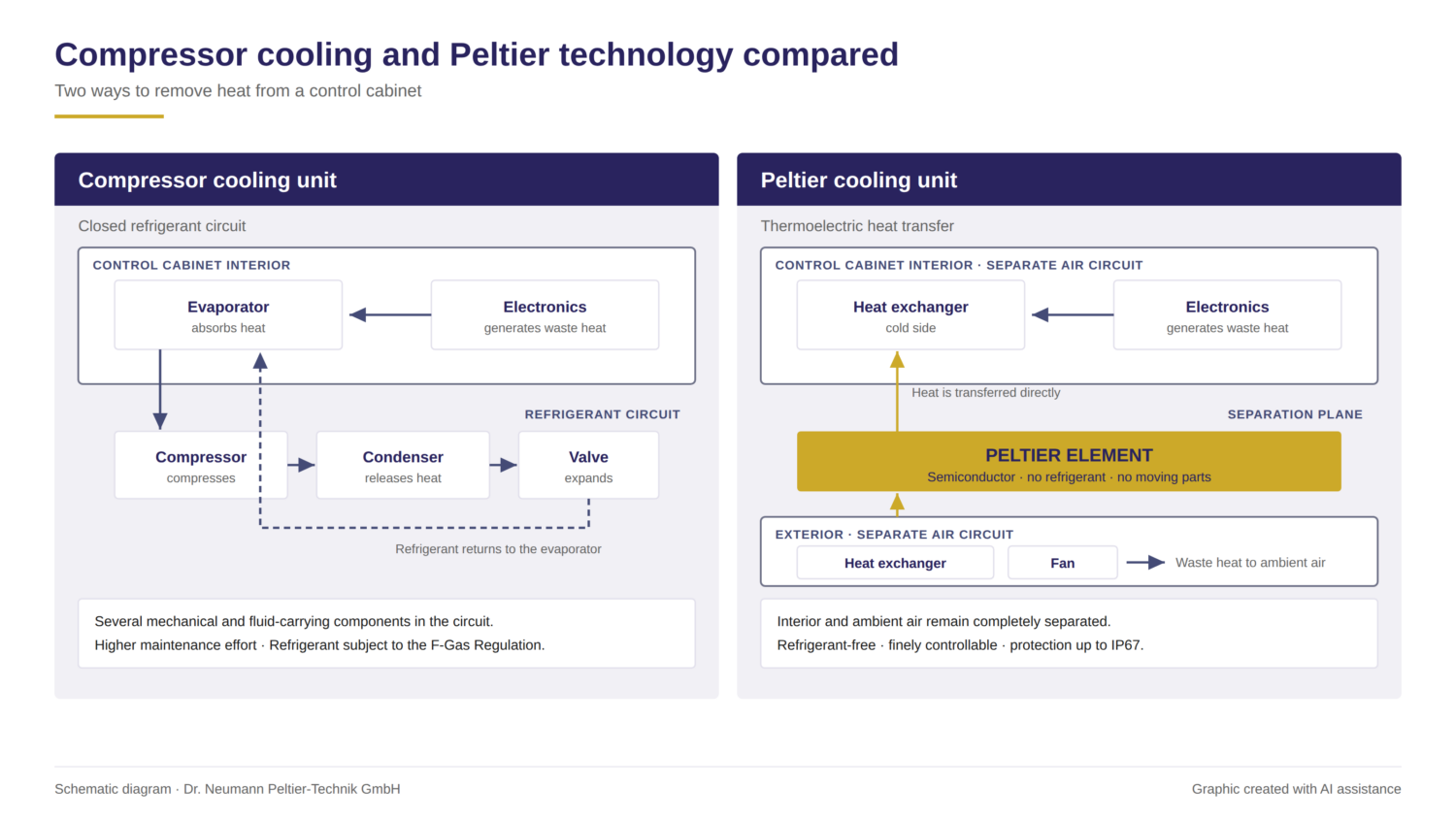
A compressor cooling unit works with a closed refrigerant circuit. The refrigerant absorbs heat at the evaporator, the compressor compresses it, and at the condenser it releases the heat to the surroundings. This requires several mechanical and fluid-carrying components: compressor, pipework and usually valves. The design is therefore considerably more complex than a comparable Peltier system – with correspondingly higher maintenance effort and risk of failure.

A Peltier cooling unit transfers heat directly through a semiconductor, the Peltier element. When direct current flows through it, one side becomes cold and the opposite side warm. Heat exchangers carry the heat away, and fans provide the air circulation. Interior and ambient air remain in two separate circuits. Unlike with a filter fan, no contaminated ambient air enters the enclosure. The cooling element itself works without refrigerant, compressor and moving parts. This is why it is referred to as solid-state cooling.

The direction of the current determines the direction of heat transfer. By reversing the polarity, the same unit cools or heats. The heat flow can be finely metered via the current level. These inherent properties give rise to the following advantages.

Below around 400 watts of cooling capacity, Peltier technology plays to its strengths. The semiconductor element is flat, a bulky compressor is not needed, and the refrigerant circuit is eliminated. This makes compact cooling units possible for small enclosures and confined installation space.

Efficiency is often lower than that of a compressor solution. In practice this is put into perspective: Peltier units can be matched more closely to the actual demand of a compact enclosure. Compared with an oversized compressor system, the overall energy balance can therefore turn out better.

Sound thermal design remains decisive. It has to account for the electrical power loss, the enclosure surface, the thermal insulation, the required internal temperature and the maximum ambient temperature. Correctly dimensioned, a Peltier cooling unit achieves a high power density with a small footprint.

Without a compressor and without a refrigerant circuit, thermoelectric cooling is inherently less sensitive to mounting position and movement. This pays off in vehicles, in mobile machinery and in rail and transport applications. Frequent start-ups and changing orientation are also uncritical for the Peltier element.

An air-cooled complete unit does not, however, work entirely without moving parts. Fans are usually fitted on the warm and cold sides. Mechanical complexity is nevertheless considerably lower than in a compressor system. This reduces noise, maintenance effort and the risk of leakage.

In Peltier systems, the electric current is the direct control variable for heat transfer. It can be adjusted continuously and, with suitable control technology, very precisely. Instead of switching a compressor on and off or working with bypass valves, the cooling capacity follows actual demand. Temperature fluctuations and pronounced switching cycles are largely eliminated.

Laboratory and test cabinets show how precise thermoelectric temperature control can be. Control accuracies of 0.1 K are implemented there. With a specialised controller, 0.05 K or better is achievable in suitable systems. For less demanding tasks, a simple thermostat solution remains more economical. It reliably keeps the enclosure within a defined temperature range and thus protects against damage from overheating or undercooling.

The accuracy actually achieved inside the enclosure depends on the overall system – on sensors, controller, air routing, thermal load and ambient conditions. The operating principle, however, creates very good conditions for stable setpoint temperatures.

By reversing the direction of the current, the unit heats actively. Outdoors, the permissible temperature window can thus be maintained in both directions without installing a separate heater.

Peltier cooling units require no refrigerant. This eliminates leakage risks in the refrigerant circuit as well as the associated maintenance and disposal obligations. This aspect is gaining weight: the F-Gas Regulation is progressively restricting the use of fluorinated greenhouse gases, and work on the refrigerant circuit of a compressor system may only be carried out by certified specialist companies.

A sealed Peltier cooling unit also separates the internal from the external air circuit. Ambient air does not enter the control cabinet. Dust, moisture and aggressive ambient air stay outside. Units designed accordingly achieve protection ratings up to IP67 and are therefore suitable for outdoor use and for heavily loaded industrial environments. Variants for salt-spray-exposed coastal regions or locations at risk of sandstorms are also possible.

Further practical advantages are DC operation, flexible mounting, quiet running and low maintenance effort. Particularly with enclosures that are hard to access in infrastructure projects, this noticeably reduces operating costs. If the heating function is added, the system architecture is simplified further – one complete solution for enclosure climate control instead of two separate systems.

When compressor cooling remains the right choice

Peltier technology is not the most economical solution for every cooling task. Where high cooling capacities are needed continuously, or where a large temperature difference has to be overcome, a compressor system generally achieves higher efficiency. This applies in particular to large, stationary control cabinets with high constant power loss and sufficient installation space.

For simple applications without particular requirements for control accuracy, robustness or protection rating, established compressor technology also remains sensible.

Conclusion: with Peltier vs. compressor cooling, the application decides

Thermoelectric cooling units are specialists for demanding tasks in the low and medium power range. Limited space, installation in the field, vibration or particularly precise temperature control speak for Peltier technology. It combines a compact design with refrigerant-free operation, fine controllability and robust solid-state technology. Maintenance is essentially limited to the fans.

Continuously high loads, large temperature differences and sufficient installation space speak for compressor cooling. The question is therefore not which technology is better, but which one suits the load profile, the environment and the available space.

Dr. Neumann Peltier-Technik develops thermoelectric cooling solutions for exactly these operating conditions. Application-specific thermal design ensures that cooling capacity, protection rating, control and form factor work together. Talk to us about your load profile – we will assess which technology carries it. Use the form to receive an individual recommendation for cooling your control cabinet.