Special Constructions
Upon request, Dr. Neumann Peltier also provides customized solutions tailored precisely to your application.
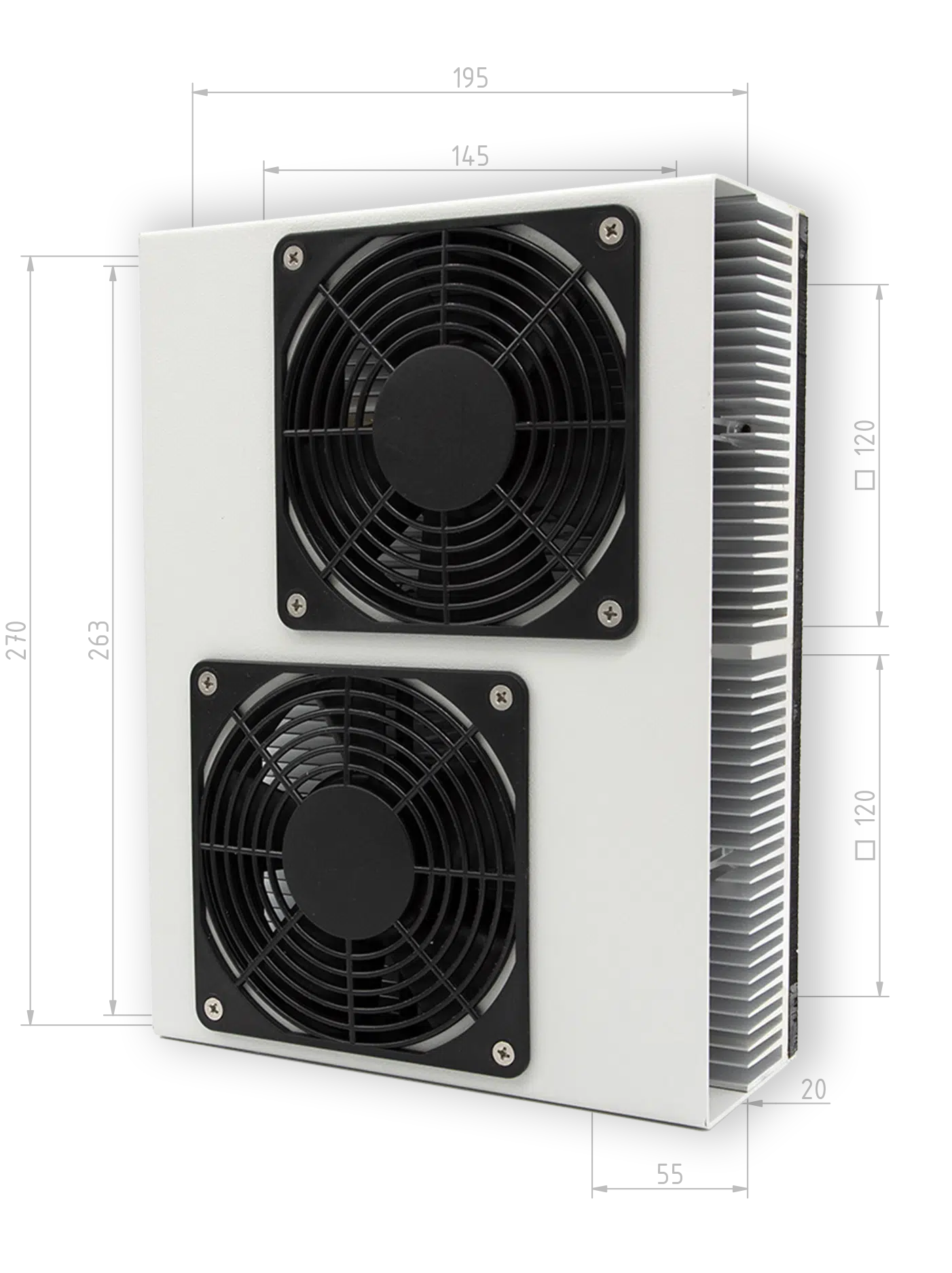
Upon request, Dr. Neumann Peltier also provides customized solutions tailored precisely to your application.
Peltier Effect modules have a very simple design, similar to a sandwich. A series of silicon rods is positioned between two ceramic plates and electrically powered as required (heating or cooling). However, as with everything that initially sounds simple, the real advantage lies in the precise design, positioning, and control of this technology. Only by mastering these aspects are we able to achieve efficiencies of up to 94% while minimizing power consumption and the number of modules required.
In addition to our standard product range, we also offer a complete project support service — from consultation and design to manufacturing according to specific customer requirements. Even in customized projects, we remain committed to our promise of quality. No project is too unusual or too complex for us. With 70 years of market experience and expertise in Thermoelectricity, we provide our customers not only with high-quality products, but also with optimal consulting and development support for their projects. We also operate as an OEM manufacturer and supplier.
At Dr. Neumann Peltier-Technik GmbH, we provide you with a well-founded proposal for the optimal Peltier Effect solution, including the appropriate Peltier modules and the complete manufacturing of your assembled unit. We have been doing this successfully for many years — both for long-standing customers and on a project-by-project basis. Whether it involves complete cabinet or assembly series production, or individual test benches in small quantities, we deliver reliable, application-specific solutions tailored to your exact requirements.
Through our series production as a supplier, we have learned how to integrate seamlessly into complex industrial processes and production environments. At the same time, the development of test benches and our engineering support in areas such as satellite technology, gas drying, and chuck production enables us to remain highly flexible and technologically up to date. These diverse and demanding applications continuously motivate and challenge our team to explore reliable and innovative solutions — often beyond conventional approaches and established standards.
The task was to precisely control the temperature of a satellite communication link.
The aerospace industry presents unique challenges in terms of weight, durability, distance, and temperature. Nevertheless, it still relies on “earth-based materials” and is therefore subject to the same physical laws as applications here on the ground. Our task was to bring the satellite’s electronics from extreme orbital temperatures to stable, electronics-friendly operating temperatures before establishing the communication link — ensuring both optimal performance and long-term reliability.
The task was to dry gas.
The challenge was to still have usable, ready-to-use gas afterwards.
In practical terms, many gases contain moisture when they are transported or processed, especially in pipeline systems or under pressure conditions. However, to maintain consistent usability and performance, this moisture must be reliably removed — essentially by means of a highly controlled “water separator.”
We developed such a system using precise control technology combined with Peltier Effect modules. The result is a highly stable and efficient drying solution integrated into a compact assembly. Our customer now incorporates this unit into their products and distributes it globally.
It is also worth noting that these assemblies are customized down to the visual level: even the display interfaces are branded in the customer’s corporate identity (CI), including their specific login and color scheme.
The task was to permanently seal punchings, drill holes, and weld seams on industrial equipment after processing.
Today, this is typically done by robots — of course. However, the robot itself only moves to the defined positions and applies a suitable sealing material to the specified areas. That’s it.
But this only works reliably if the dispensing system is continuously supplied with material at a precisely controlled temperature at the nozzle. If the material becomes too warm, it loses viscosity and flows uncontrollably. If it becomes too cold, it solidifies and clogs the entire system, which is then extremely difficult to clean and restore.
We produce two solutions:
1. We design and manufacture a temperature control unit that is mounted directly on the robot arm. The dispensing material flows through this unit, ensuring it is precisely temperature-controlled and delivered to the application point under optimal conditions.
2. This solution is integrated into the robot control system and operates a third-party product that is capable of temperature regulation, but not with the same level of precision as Dr. Neumann Peltier-Technik GmbH.
The task was to design a customer-specific test bench for thermally testing power electronics.
The customer sells several hundred units of a power diode each year and thermally tests every single one of them. We were commissioned to design a fixture that securely holds and electrically contacts these diodes.
Once inserted and contacted, each device under test is then heated and cooled under precisely identical and reproducible conditions. The test bench also had to be integrated into the customer’s existing test environment, as data acquisition is handled internally by the customer in this case — although we would have been fully capable of providing this via our own control system as well.
The task was to develop a control system capable of operating and monitoring multiple Peltier Effect setups simultaneously.
The experimental setup at the research facility was already in place, with several identical laser paths operating in parallel. Each of these optical paths was precisely cooled using Peltier Effect modules.
However, each individual line had its own power supply, its own sensors (AD590), and its own TEC controllers. As a result, data acquisition and system monitoring became complex and difficult to manage in a unified way.
To solve this, we integrated our XS controllers together with a COMM-PRO board and the appropriate power supplies into a 19” rack system. The setup was equipped with displays and designed for centralized operation. Using the multi-node functionality of the COMM-PRO system, all units can now be accessed, monitored, and controlled via a REST API over the network — enabling scalable, structured, and fully remote system management.